
Kendall County Court Records After a Jail Arrest
An arrest does not by itself create a court case. After someone is booked into the Kendall County Jail, the Kendall County State's Attorney reviews the police and jail materials and decides what to file. The elected State's Attorney, Eric Weis, has the statutory job of prosecuting violations of Illinois criminal and traffic law and Kendall County ordinances. Once a charge is filed, a case opens in the circuit court, and that case is the court record people search for after an arrest.
The booking side and the court side are two different records. For the roster, booking number, and custody status, use the jail inmate records page, and for booking photos use the jail roster mugshots page. The court record, by contrast, lives with the Kendall County Circuit Clerk, where the charges, hearings, filings, and disposition are kept. Reading both together gives the full picture from arrest through court.
The usual path runs in a clear order: Arrest, then Booking at the jail, then a first appearance, then the prosecutor files the charge, and finally the case opens as the court record. Each step can add or change information, and the court file is the part that follows the case to its end.
How to Find Kendall County Court Records After an Arrest
The Circuit Clerk runs the online court records search. The clerk, Matthew G. Prochaska, maintains the official court records filed in Kendall County, which sits in the 23rd Judicial Circuit. The online system lets you search by participant name or case number, and it works best in Chrome or Firefox. The Illinois Supreme Court Electronic Access Policy limits which documents appear online, so some filings can only be read in person.
- Open the Circuit Clerk online court records page and choose a search method.
- Search by the defendant's name, or by case number if you have one.
- Open the case and read the charge list, hearing dates, and entries.
- Check each charge's status, and compare the case opening date to the arrest and booking date.
For documents that are not online, the courthouse viewing room is open Monday through Friday from 8:30 a.m. to 4:30 p.m., excluding court holidays. The eMagnus help desk at 1-800-250-9884 assists with the portal. The Kendall County Courthouse, shown in the Illinois Courts directory below, sits at 807 W. John Street in Yorkville.
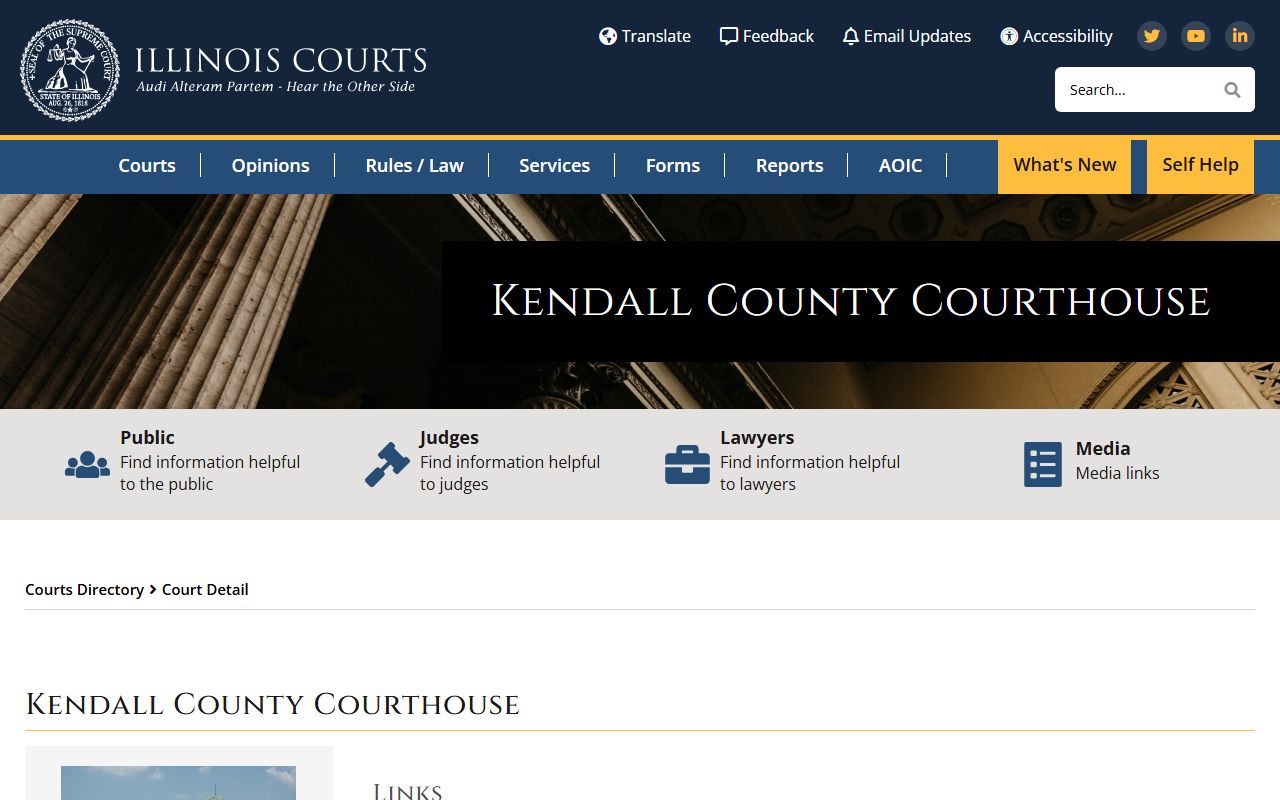
The Illinois Courts directory lists the courthouse address, hours, and parking, and the online court records page is the place to start a case search. A name search can fail when a spelling, middle name, or alias differs, so use the case number whenever you have one. The Circuit Clerk's main page also offers eNotify and electronic filing options for people following an active case.
How Charges Get Filed After an Arrest: Complaint, Information, and Indictment
The court record opens when the prosecutor files a charging document. Booking happens first at the jail, then the State's Attorney decides whether to charge and what document to use. There are three main types, and the choice usually tracks how serious the alleged offense is.
| Complaint | Information | Indictment | |
|---|---|---|---|
| Filed By | Officer or prosecutor | Prosecutor | Grand jury |
| Common For | Misdemeanors | Many felonies | Serious felonies |
| Starts | The case | The case | The case |
The booking charge and the filed charge are not always the same. The prosecutor can file as booked, decline some counts, add counts, reduce a charge, or take a matter to a grand jury for an indictment. That is why a roster charge should be treated as a starting point, not the final court charge.
Charge Status and What It Means
Charges shift as a case moves through court. A count can be amended, reduced, added, dropped, or dismissed, and the court record tracks each change. Reading the status terms keeps you from misreading a case. A pending charge is still an accusation, not a finding of guilt.
| Status | What It Means |
|---|---|
| Pending | The charge or case is open and not yet resolved. |
| Amended / Reduced | The prosecutor changed the charge, often to a lesser offense. |
| Dismissed | The charge or case ended without a conviction on that count. |
| Nolle Prosequi | The prosecutor chose not to pursue the charge at this time. |
A jail release date does not equal a dismissal. A person can be released before trial and still have an open case, so check the court record rather than reading too much into a release.
Release and Detention After an Arrest
Illinois changed how release works after an arrest. Under Article 110 of the Code of Criminal Procedure, most people charged with an offense are eligible for pretrial release, and a defendant is presumed entitled to release on personal recognizance with conditions such as attending court and not committing new offenses. The state ended routine cash bail through its pretrial fairness framework. Some legacy bond language remains on local pages for court payments or previously posted security, so always check the current court order for the specific case.
| Outcome | How It Works |
|---|---|
| Release on recognizance | Release on a promise to appear, without a money deposit. |
| Conditions of release | The court sets terms such as check-ins, no contact, or monitoring. |
| Pretrial detention | The court orders the person held under the Article 110 standard. |
| Hold or detainer | Another agency's authority blocks release even if a local condition is met. |
The Kendall County Sheriff's FAQ still describes posting bond at the Sheriff's Office around the clock for certain court-ordered payments. A hold for another agency, an ICE detainer, a parole hold, or a warrant from another county can keep a person in custody after an arrest even when a release condition is satisfied.
Warrants That Lead to an Arrest
A warrant is one common road to a booking. An arrest warrant authorizes taking a person into custody, and a bench warrant is issued by a judge, often after a missed court date. Kendall County does not publish an official online active-warrant search, so an absence of an online listing does not prove there is no warrant.
To check, contact the Sheriff's Records Division at 630-553-7500, where staff handle warrants, or review the court docket through the Circuit Clerk, since bench warrants tie to case entries. Setting eNotify on a case number can send court-date reminders that help prevent a future failure-to-appear warrant. Resolving a warrant usually means a court appearance, surrender, or attorney action, not a records request, so seek legal advice rather than relying on an online check.
Charges vs. Convictions After an Arrest
Being arrested and charged is not the same as being convicted. A charge is an accusation; a conviction is a verdict or plea. Both can appear in public court records, but they carry very different weight.
| Charge | Conviction | |
|---|---|---|
| Stage | Accusation | Verdict or plea |
| Burden of Proof | Probable cause | Beyond a reasonable doubt |
| Public Record | Yes | Yes |
Reading a court record carefully matters here. A case may show several charges at filing that were later reduced or dropped, leaving a conviction on only one count, or none at all.
Sealed vs. Expunged Arrest Records
Illinois lets people clear qualifying arrest and court records under a sealing and expungement statute. Sealing hides a record from most public view, while expungement destroys or impounds it so it is treated as if it never existed. Both are court processes with eligibility rules, and neither happens automatically after a dismissal.
| Sealed | Expunged | |
|---|---|---|
| Visibility | Hidden from public view | Destroyed or treated as never existed |
| Law Enforcement | Limited access | Very limited access |
| Eligibility | Set by 20 ILCS 2630/5.2 for qualifying records | Set by 20 ILCS 2630/5.2 for qualifying records |
The governing law is 20 ILCS 2630/5.2. A court order to seal or expunge does not control copies that already left official systems, so old cached material may need separate handling.
Requesting Copies of a Court Case
For copies of a court file, the Circuit Clerk's copy-request process applies. The preferred route for non-certified copies is the re:SearchIL electronic system. A written request should include the requester's name, address, daytime phone, the case number if known, the party names, and the document wanted. The requester pays statutory fees and is told the charge before processing.
| Item | Fee |
|---|---|
| Copies, first page | $2.00 |
| Copies, next 19 pages (each) | $0.50 |
| Copies, remaining pages (each) | $0.25 |
| Certified copies (per page) | $6.00 |
Checks or money orders are payable to the Kendall County Circuit Clerk. The copy-request page and the re:SearchIL system carry the full instructions.
Background Check Considerations
A casual court-record lookup is not the same as a regulated background check. Formal employment, tenant, credit, and insurance screening must follow the federal Fair Credit Reporting Act and use a licensed consumer reporting agency. Court records you read on your own do not meet that standard.
Important: This site is not a consumer reporting agency under the FCRA, and nothing here may be used for employment, tenant, credit, or insurance decisions.
Restricted Court Records After an Arrest in Kendall County
Not every court record after an arrest is open to the public. Juvenile matters, sealed charges, and records covered by an exemption can be withheld, and ongoing investigations may keep some material out of public view. The Illinois Supreme Court Electronic Access Policy also limits what shows online even when a paper file exists at the courthouse.
If a record you expect to find is missing online, that does not always mean it is gone. It may be restricted, sealed, available only in the viewing room, or filed under a different name or case number. The Circuit Clerk and the courthouse viewing room are the right next stops for a record the portal does not display.